Monday, December 24, 2007

On the Tempe trail


What's a road trip without a few random stops?

Jeff Poteet, TGOM's roommate first class, took the time to plot out several possible escapes from the long and winding road. Here's a link detailing our cross-country route with each letter corresponding to the following sites:

A. MONUMENT CIRCLE (Indianapolis, Ind.) - Well, we have to start somewhere. After rounding Indy's venerated loop, we'll make a beeline for Interstate 70.

B. World's Largest Cross (Effingham, Ill.) - It wouldn't be a bad idea to stop at the giant cross at the intersection of Interstates 57 and 70 about 150 miles into our trip. We could say a prayer for a safe trip, appeal to The Big Guy on the Hoosiers' behalf or give a shout out to Coach Hep. It took a few miraculous plays to get IU to Tempe, might as well recognize the greatest of all the miracle workers.

C. Giant Catsup Bottle Water Tower (Collinsville, Ill.) - Only in America can you find a mammoth condiment dispenser stretching 170 feet into the air. As someone who has been subjected to countless ketchup jokes due to a certain ketchup manufacturer beginning with the letter "H," I may just cringe at the sight of this tomato monstrosity. And can we please settle this catsup vs. ketchup discrepancy? There isn't mustard and mosterd.

D. St. Louis Arc (St. Louis, MO) - Hopefully we catch a glimpse of the famous arc as we stop in St. Louis to pick up our common sensically-challenged friend Brad. Brad won our fantasy football regular season title this year. He also once told a girl that her best feature was her arms. I'm afraid to speculate about what that says about our fantasy football prowess.

E. "Gateway to the Ozarks" (Cuba, MO) - No dictators, no missile crises, just a self-proclaimed "growing and prosperous community... within minutes of activities the whole family can enjoy." I think the next slogan should read Cuba, Missouri: Just minutes from enjoyment.

F. Big Fork (Springfield, MO) - Every memorable road trip has a critical fork in the road. Our fork could come quite literally in Springfield -- and provide a perfect photo opportunity!

G. Will Rogers Memorial Museum (Claremore, Okla.) - 600 miles into our trip may be the perfect time to pay homage to one of America's greatest entertainers. After being trapped inside a vehicle with one another for hours, we all may need a laugh by this point anyway.

H. Oklahoma City National Memorial (Oklahoma City, Okla.) - Most of us were too young to understand the full significance of the bombing that occurred in Oklahoma City in the spring of 1995, but we could always use a reminder about the destructive force of violence in this world and the role we all play in making sure such acts never occur.

I. The Leaning Water Tower and another large cross (Groom, Texas) - You can't pack enough odd water towers and giant crucifixes in one road trip.

J. Big Texan Steak Ranch and Cadillac Ranch (Amarillo, Texas) - After devouring a 72 oz. steak at the famous Big Texan Steak Ranch (between the entire group, of course), we'll spray paint a "Go Hoosiers" on the partially buried and fully vandalized Cadillacs of Cadillac Ranch before continuing to Tempe.

K. Ernie Pyle's House and Library (Albuquerque, NM) - Visiting the home of the well-known war correspondent and heroic Hoosier would be a great way to stir up some IU pride. I've spent enough time in Ernie Pyle Hall on campus to understand the significant contributions Pyle made to American journalism.

L. Continental Divide (Thoreau, NM) - So if the rainwater hits this side of the mountain it flows to the Pacific, and if it hits that sound of the mountain it flows to the Atlantic. Who knew?

M. Wigwam motels (Holbrook, AZ) - The true reason we are making this trip is to sleep in a wigwam.

N. Meteor crater (Winslow, AZ) - Before Coach Hep gave IU its Rock, the extraterrestials sent Earth theirs.

O. Heart Attack Grill (Phoenix, AZ) - Our pot of gold at the end of the rainbow? The Double Bypass Burger.

P. SUN DEVIL STADIUM (Tempe, AZ) - Behold the promised land.

Monday, December 10, 2007

Coming Soon: Bowl Road Trip Diary


Ten men. Two vehicles. 3600 miles of road. The figurative culmination of 4 years of randomness, outrageousness and athletic devotion.

After enduring three seasons of heartbreaking IU football, 10 IU seniors (including TGOM's finest) will traverse this expansive nation to witness the greatest accomplishment by an IU team in 14 years: a bowl berth.

On Dec. 31, the Indiana Hoosiers will take on the Oklahoma State Cowboys in the Insight Bowl in Tempe, Ariz. I, along with nine other comrades - many of whom I've known my entire college career - will be there to cheer the Hoosiers on - because who knows if IU will ever make it to a bowl again before we are middle-aged, balding and irritable.

We witnessed DiNardo's final year (at least when we weren't covering our eyes). We embraced Coach Hep. We saw Kellen Lewis enter the game against Ball State as an unknown freshman and found hope. We felt concerned when Coach Hep left the sidelines, and we cried when he left this earth before any of us were prepared. But now the Hoosiers are playing thirteen. Now we have a team to rally around. Now we finally get to celebrate.

Austin Starr's field goal to bring the Old Oaken Bucket back to Bloomington and give IU it's first winning season since Saturday morning cartoons were the highlight of our week sparked a gridiron celebration unlike anything we could have imagined as scrawny freshmen. That was before The Rock was The Rock, before Coach Hep wanted us, before James Hardy became a man.

For us fellas, it's been a wild ride with plenty of highs and lows, but we're glad we stuck it out. We're glad we drug our asses across the tailgating fields into Memorial Stadium on those autumn Saturdays. We're glad we will be bringing in the New Year under a desert sky.

Our trip officially begins on Dec. 28 in Indianapolis and ends on Jan. 3. TGOM will be blogging the whole thing, right down to the 3 a.m. rest stop in Scalphead, Okla.

Plenty of incriminating pictures, recollections - maybe even videos - to follow. Until then, Go Hoosiers!

Wednesday, October 24, 2007

Transition blog


Question: What kind of stuff is posted on a travel blog after the trip is over?


Answer: Whatever I want.


My brazilian experience may be stuck on To Be Continued, but my life is far from being on hold. Currently, I am sweating through a semester of journalism ethics, magazine writing and Portuguese Literature while working late nights as the sports editor of the Indiana Daily Student. I also get to be the men's basketball team's biggest fan and critic as an IU columnist.


My mind is consumed with deadlines but far from dead. Case in point, below is a little self-narrative I wrote as part of my application for a feature writing contest. Sometimes it's important to remind yourself why you're putting yourself through hell in the first place.


I've always been a reader -- even before I could read by myself. As a child, I would ask my parents to read to me at every opportunity. I could never settle for one book, of course, so inevitably a stack of illustrated tales would end up at the feet of the nearest literate person with me anxiously awaiting to begin. Even today, few things are more exciting to me than opening to the first page of a new book.
In addition to reading, I've always loved sports. Well, not always. But ever since that day in the schoolyard when I discovered catching a football could lead to making a new friend, sports have been my thing. They help me relate to other people and, in turn, to myself. At an early age, however, it became evident that my athletic aptitude was far inferior to my skill with words. So when a relative gave me a book entitled The Best American Sports Writing of the Century which combined two of my passions in an articulate and inspiring way, I discovered a new goal in my life: to make it into the 21st century edition of that book.
It's a rather lofty goal. Even the best sports writers of the past century needed a little luck to land a spot in the 816-page collection. I'm still looking for my big break.
As a journalism major at Indiana University and a staff member at the Indiana Daily Student, I have covered IU athletics as a columnist and a reporter since 2005. Currently, I am one of the sports editors at the IDS. The experience has been challenging and rewarding at the same time. Earlier this year, I was awarded a national sports journalism scholarship by the NCAA partially based on my work as the IU sports columnist in the fall of 2006. It was quite an honor.
At IU, I've had the pleasure of covering a variety of sports from field hockey to men’s basketball. It’s the interaction with coaches and players as well as the response from readers that have made the experience memorable.
Sports are just a gateway, however. The more I write about them, the more certain I become that I am not writing about sports at all. I'm writing about people, and -- through people -- I am writing about life. The best of the sports pages -- or any page, really -- tells tales of defeat and triumph, mystery and discovery, guilt and love. In this way, the stories I write today aren't that much different from the ones I adored as a child.
These stories are everywhere; they are the product of life being lived. As a journalist, I've taken it upon myself to seek them.

Saturday, September 15, 2007

Reflections on a past life

As of this post, I have been back in the United States for nearly two months. It might as well be two decades.

It's interesting to note the way humans adapt to their environment so effectively out of necessity and the need for social interaction. I smile (and occasionally laugh out loud) thinking of some of the uncharacteristic experiences I had in Brazil - experiences I will be hard-pressed to replicate anywhere else in the world. (Sigh...)

Hopefully, I'll get to visit other places in the world someday. Maybe I'll even get a chance to return to Brazil. The future is full of possibility.

The following is an essay I wrote for the Hutton Honors College International Experience Grant I received before studying abroad. Thanks to the generosity of Edward L. Hutton, thousands of IU students like me don't have to dig quite so deep into our parents' pockets to make a dream come true.

My group of twenty-five American students walk off our private bus onto an unfamiliar street 40 minutes outside the center of São Paulo, the most populous urban habitat in the southern hemisphere. Our driver has taken us west across the polluted river towards the poorer periphery of the metropolitan giant. He navigated the shifting, tangled web of traffic and infrastructure as if possessing a sixth sense as we chatted expectantly in the back of the vehicle. Though we are all accomplished college students, field trips still excite us.

As we cross the street and pass through a gated entryway, I can’t help but notice the disheveled look of the place. The building is ugly. All concrete and chipped paint. Hardly an optimum environment for learning. I am about to tour a public school in Brazil.

The principal comes to greet us outside the main door. She smiles as she addresses us gringos, sharing with us information about the school – the number of students enrolled, the shoestring operating budget, the night classes offered to those who work during the day. She is proud of her school’s role in the neighboring community.

We enter through a small common room and into a courtyard. Two young boys, seemingly on their own, stand by a pile of rocks and rumble. They stop what they are doing to watch curiously as our group observes the area. The expressions on their faces grow especially animated when they see me.

I see a covered gym area where kids are playing with balls of various shapes and sizes. We move on. I sit in a stuffy one-room library with the world map that needs updated. We hear about the children’s book program being implemented by the government. There’s more to see. I smile awkwardly in front of a class of dark-haired adolescents that smile awkwardly back from their desks. It’s difficult to determine who is studying who more intensely. We view the new computer lab with the government-funded machines and drab walls. Some of us are impressed – considering the circumstances.

We see it all in less than an hour. As my group readies itself to leave, I stand patiently in the common room we entered from the main door. It appears to be a cafeteria right now. Bright-eyed children carrying bowls of rice and beans partake around me. Some sit and eat. Others stand. I can feel their stares lingering on me, crawling up my long frame. It’s as if I am the only foreigner in the room. They have never seen anything like me before.

The small one addresses me. Asks me a question. I stoop down and tilt my head towards his voice, carefully weighing every word. “How tall are you?” he asks.

“One-hundred and ninety-five centimeters,” I reply. It’s a question I’ve been asked before. The boy continues to gawk openly. A few of his classmates join him.

“Do you play basketball?” one asks.

“Of course,” I say, not voluntarily elaborating beyond a basic confirmation.

Now the dam has been breached. I’m surrounded on all sides as more children press closer. They want to get a good look at me – take in my staggering height, my light-colored hair, my clown-size feet. Where are you from? What is your name? What size are your shoes?

The imperative questions travel through the air towards the ceiling, towards my face. I look intently at each questioner, making sure to pronounce my words clearly. One boy tells me he plays basketball too. Another tells me he has heard of the United States, but has never visited. One courageous girl races up to me and places her foot next to mine before quickly sprinting away in laughter like she had just touched a hot burner and escaped the consequences.

Someone tells me it is time to leave. I wade through a sea of rambunctious midgets to get to the door, saying my goodbyes. Taking one last glance through the slotted metal doors, I can still see the curious faces looking back. A final thought passes between my ears as I walk away: Maybe this building isn’t so ugly afterall.


Sunday, July 15, 2007

The long and winding road

Backpacking in Argentina has been an exhausting experience, but it has also been a blast!

I spent three days near the Andes mountains in Mendoza in central Argentina and three days among the dry, rocky terrain of Salta in northern Argentina. I rode three buses for a combined 48 hours and met people from all corners of the world. I saw the white-tipped peaks of the Andes and the pastel colors of the rocks in Salta. I drank fine wines and tasted fatty meats. I peered into the eery pools of salt flats and got lost in a maze of Incan ruins. I climbed into canyons and parasailed above cliffs. I survived entire days on a diet of cookies. I took chances and made mistakes, but I learned a little more about this crazy world - and that made it all worthwhile.

I'm tired. I'm weary. I'm ready to go home.

So that's just what I'll do.

Wednesday, July 4, 2007

International day-tripper


I took a day trip to Uruguay the other day. I get a kick out of typing that sentence. Growing up in Indiana, the only feasible day trip to another country is Kentucky - and that really isn't worth the gas money.


Uruguay is my fourth South American country to have visited for those of you keeping track at home. Barring any dramatic turn of events, my country-counter will be at four when I return to the United States.


To get to Colonia del Sacramento, a small Uruguayan historical town, I took a ferry from a nearby port across Rio de la Plata, the largest estuary in the world. An estuary is a place where one or more rivers meet before hitting the ocean. Looking out across Rio de la Plata, you'd think it was the ocean. The ferry that I took was really nice inside with a cushiony seats, TV, concessions - even a small store. It took 45 minutes of comfortable water-churning to make it to Colonia from Buenos Aires.


Colonia used to be a major point of contention between the Spanish and the Portuguese, strategically located outside the joining of the Parana and Uruguay River. It was conquered and re-conquered several times in its history. Seeing that the common language in Uruguay is Spanish, I guess it's not hard to guess who won in the end.


It's the dead of winter here, so the tourists aren't exactly flocking to the port city these days. It was pretty much me and a few American tourists wondering why they were wearing sweaters and jackets in July. The historical section reminded me a lot of Paraty, the other historical Portuguese port I had visited in Brazil last January. I guess if you have seen one colonial port, you´ve seen them all. We can now add old Portuguese ports to a list that includes Wal-Marts, wax museums and civil war battle fields.


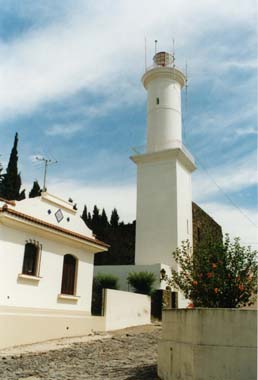
I am traveling solo these days, so the highlights of Colonia del Sacramento were marveling at the breadth of Rio de la Plata atop the lighthouse and serenading a stray cat and a sea dog at the end of the pier. They were a very attentive audience.


It was a grey and blustery day, so I took the ferry back in the afternoon.


Uruguay seems like a much more relaxed place than Brazil or Argentina, although its currency makes me uneasy. The Uruguayan peso is something like 22 to the dollar and most things cost in the hundreds of pesos. It's hard to decide what to order for lunch when you see that it is going to cost you in the hundreds. With all the large numbers floating aroung in that country, I wished I would have brought a calculator.


One of the things about taking an international ferry is that you have to go through customs before and after the trip. Customs is always an adventure for me - especially since my passport was accidently washed in the washing machine. It looks like an historical document with its worn cover, smudged ink and creased pages. I like to say that it has character.


Customs officials do not seem to appreciate my colorful passport, and with all the random slips of paper they hand you during these trips (boarding passes, receipts, entry/exit cards, etc.), it can get a little confusing. It seems like I spent half my day figuring out paperwork.


In the end though, I'm glad I made the trip. Not even Kentucky has a lighthouse.

Monday, July 2, 2007

As different as their dance


I boarded my plane for Buenos Aires ten minutes after it was supposed to depart. Sometimes, you've gotta love Brazilian airlines. I knew I was leaving Sao Paulo for an entirely different city in South America, but how different, I had no idea.

After three days in the capital of Argentina, I can tell you that the cities are as different as the tango and the samba.

Buenos Aires used to be considered the New York City of South America about 100 years ago, the financial and cultural capital of the continent. Of course, today the financial hub of South America is Sao Paulo, but Buenos Aires still packs a cultural punch.

I spent my first day in the city taking a first-class, personal tour of the area courtesy of a couple of American friends. It was a great way to learn about the history and the variety of BA. From the beginning it was apparent that Buenos Aires is different than any Brazilian city I've visited. The streets meet at clean, 90-degree angles, you don't feel like your suffocating in concrete and it's really not necessary to look over your shoulder every couple minutes to make sure you're not being followed.

On my tour, I got to see the variety in architecture that exists and learned oodles about the neighborhoods. I saw the colored houses of La Boca, the renovated industrial buildings near the river, which now offer restaurants like Hooters, and the granite mosques of the wealthy in La cemeterio de la Recoleta where the body of Evita Peron rests. I am staying in an apartment in the neighborhood of San Telmo, an historical area which used to house the city's wealthy before an outbreak of yellow fever in the mid-19th century. The architecture in San Telmo is supposedly Spanish, and the neighborhood is currently undergoing a revitalization process. At different points, I've heard parts of Buenos Aires compared to Paris, New York and New Orleans. All I know is that it definitely isn't Sao Paulo.

Even the people are classy. At one point during my tour, the money pouch that I had strapped around my waist beneath my sweatshirt fell off onto the ground. Before I had even noticed its absence, a man had picked it up, looked at the name on the debit card and was looking for the owner. I had my only way of withdrawing money and 100 pesos in that thing and found it before I even knew it was lost! Had I lost my debit card and cash in Brazil, I am 99.9% sure I would not have got it back.

We made some stops at historical cafes, nice restaurants and extravagant churches. I drank the richest cup of hot chocolate in my life at Cafe Tortoni, a cafe famous for having regulars such as the author Luis Borges. I got a better taste of Argentine beef on Friday and Saturday. (I think the beef I had on Argentina's side of Iguacu is why I was running to the bathroom that night.) I also visited an art museum and toured an old navy ship that was active around the turn of the 20th century. On Saturday night, I had my cheapest night/morning out abroad at an Irish pub/club. Argentines likes to go out late as in early-late. I made sure to take a nap beforehand.

The exchange rate here is much more favorable than in Brazil. The peso is around three to the dollar, and food and public transportation seems dirt cheap. Argentines seem much better educated than Brazilians as a society. I heard the average Argentine reads more than seven books a year. That is several times more than the average Brazilian. Instead of focusing on the body like Brazilians, Argentines prefer to obsess over the mind. The psychiatrist replaces Brazil's plastic surgeon as the glamor profession. It's common for the residents of Buenos Aires to visit their psychiatrist regularly to improve their mental and emotional health. To me, this seems nuts.

Another noticable difference between Sao Paulo and Buenos Aires is the racial makeup. People appear far more homogeneous here than in Sao Paulo, although the blue eye/blond hair combo is just as uncommon. I no longer see the Asian and African characteristics that are common a country away.

Although Portuguese and Spanish are very similar, there are enough differences to make communication a challenge at times. Pronunciation is completely different. Luckily, a lot more tourists frequent Buenos Aires and many people speak English.

The weather is a tad chilly, hovering around 50 degrees during the day and 40 degrees at night. Makes me wish I'd packed a few more long-sleeved shirts and a few less pairs of shorts, but I'll survive.

On July 5th, I'll be traveling west towards the Andes mountains to the wine country of Mendoza. Then, I plan on going north to Salta, where the dry climate and low pressure create a unique climate.

It will be my first time outside of urban life since April. Definitely gonna soak it up.